I awoke with Marvin Gaye's song "God Is Love" running through my head (you can listen to it here):
Oh don't go and talk about my father
God is my friend
Jesus is my friend
He made this world for us to live in,
and gave us everything
And all he asks of us is we give each other love.
Oh ya
Don't go and talk about my father
Cause God is my friend
Jesus is my friend
He loves us whether or not we know it
Just loves us, oh ya
And He'll forgive all our sins
Forgive all our sins
And all He asks of us, is we give each other love.
Oh ya
Love your mother, she bore you
Love your father, he works for you
Love your sister, she's good to you
Love your brother,
your brother
Don't go and talk about my father, He's good to us,
God is my friend
Jesus is my friend
For when we call in Him for mercy, Mercy Father
He'll be merciful, my friend
Oh, yes He will
All he asks of us, I know, is we give each other love,
Oh ya
Friday, March 28, 2008


Wednesday, March 26, 2008
Beyond Our Beginnings
Yesterday, I went to hear a panel discussion which opened the "Beyond Our Beginnings: Women Writers from Lower and Working Class Backgrounds" at Vanderbilt. Joy Castro, Karen Salyer McElmurray, Heather Sellers, Dorothy Allison and Minton Sparks participated.
When I saw this listed in Sunday's paper, I was drawn to it. I thought about who I could take with me and emailed my friend Paige, who is a writer and community organizer for Mother's Acting Up. She has a toddler and couldn't make the timing work, so I went by myself.
I'm giving myself props for going. I feel so out of place at events at universities. First of all, most everyone knows most everyone else and I never know anyone and wind up standing around like a wallflower. (I do attempt to make conversation but people are tolerantly polite until the person they're meeting shows up and then I'm forgotten.) Secondly, I feel totally out of my element. I barely made it out of high school and never felt any inclination to pursue any higher formal education (and self-education doesn't count for much in that environment). I've been a stay-at-home mom for most of my adult life. Yeah, now I work for a university in an interesting job which allows me to "pass" for one of them, but I always get "caught" when asked "Oh how interesting. Did you study sociology?"
The funny thing is that this was a group of women who all, in one way or another, probably know very much how I was feeling about passing. They all came from families in which they were the first to "escape" or get beyond their raising, the first to go to college and work in some capacity that wasn't manual labor. If I had had the foundation to establish actual conversation (rather than small talk), I'm sure I could have found much in common with many of them. But an hour's worth of panel discussion does not allow for depth.
As I rode there on my scooter, I thought about how coming from the background I do has made me a much more creative and engaged person than I probably otherwise would have been. I'm an ideas person. Often, I'm not even aware that I'm supposed to be in a box that others struggle to think outside of. In many ways, I think I see culture from an outsider's perspective, noticing what works well and is good, what things are dysfunctional and which ones are neutral. There are many, many things about our culture, of course, which I've internalized and never considered that I should become aware of and examine, but I think I have more perspective than most folks in our society because of my upbringing and background. I feel grateful, now, for my parent's lifestyle choices during my childhood (most of them, anyway).
The thought that I left with which is still resonating with me is to speak up, tell our stories, speak our truths. All of the women are story-tellers whether via fiction, essay, memoir, spoken word or short story, each of the women on the panel (and most of the audience, I imagine) tells her own story. Someone asked what the repercussion were of writing about family and each panelist said that it was absolutely necessary although very frightening at first, but came to be healing for all those affected by the stories (characters and readers alike). Telling our stories is owning our lives and saying that our voices, our experiences, our lives are as important and valid as those who comprise the dominant culture--and oftentimes much, much more entertaining.
Coming from where I did, I have a unique perspective which enriches the lives of others. I have a loud voice and the strength and creativity to catalyze change for the better in my world. I feel strongly that inviting people from a broad spectrum of society to worship with us at NFM will enrich our spiritual community: They will each bring new ways of seeing the world, helping us move outside of our narrow culturally dictated paradigm (comfort zone). The changes they will bring will not always be easy or comfortable but, if we allow Spirit to open our hearts and guide us through the changes, they will make us a better community.
When I saw this listed in Sunday's paper, I was drawn to it. I thought about who I could take with me and emailed my friend Paige, who is a writer and community organizer for Mother's Acting Up. She has a toddler and couldn't make the timing work, so I went by myself.
I'm giving myself props for going. I feel so out of place at events at universities. First of all, most everyone knows most everyone else and I never know anyone and wind up standing around like a wallflower. (I do attempt to make conversation but people are tolerantly polite until the person they're meeting shows up and then I'm forgotten.) Secondly, I feel totally out of my element. I barely made it out of high school and never felt any inclination to pursue any higher formal education (and self-education doesn't count for much in that environment). I've been a stay-at-home mom for most of my adult life. Yeah, now I work for a university in an interesting job which allows me to "pass" for one of them, but I always get "caught" when asked "Oh how interesting. Did you study sociology?"
The funny thing is that this was a group of women who all, in one way or another, probably know very much how I was feeling about passing. They all came from families in which they were the first to "escape" or get beyond their raising, the first to go to college and work in some capacity that wasn't manual labor. If I had had the foundation to establish actual conversation (rather than small talk), I'm sure I could have found much in common with many of them. But an hour's worth of panel discussion does not allow for depth.
As I rode there on my scooter, I thought about how coming from the background I do has made me a much more creative and engaged person than I probably otherwise would have been. I'm an ideas person. Often, I'm not even aware that I'm supposed to be in a box that others struggle to think outside of. In many ways, I think I see culture from an outsider's perspective, noticing what works well and is good, what things are dysfunctional and which ones are neutral. There are many, many things about our culture, of course, which I've internalized and never considered that I should become aware of and examine, but I think I have more perspective than most folks in our society because of my upbringing and background. I feel grateful, now, for my parent's lifestyle choices during my childhood (most of them, anyway).
The thought that I left with which is still resonating with me is to speak up, tell our stories, speak our truths. All of the women are story-tellers whether via fiction, essay, memoir, spoken word or short story, each of the women on the panel (and most of the audience, I imagine) tells her own story. Someone asked what the repercussion were of writing about family and each panelist said that it was absolutely necessary although very frightening at first, but came to be healing for all those affected by the stories (characters and readers alike). Telling our stories is owning our lives and saying that our voices, our experiences, our lives are as important and valid as those who comprise the dominant culture--and oftentimes much, much more entertaining.
Coming from where I did, I have a unique perspective which enriches the lives of others. I have a loud voice and the strength and creativity to catalyze change for the better in my world. I feel strongly that inviting people from a broad spectrum of society to worship with us at NFM will enrich our spiritual community: They will each bring new ways of seeing the world, helping us move outside of our narrow culturally dictated paradigm (comfort zone). The changes they will bring will not always be easy or comfortable but, if we allow Spirit to open our hearts and guide us through the changes, they will make us a better community.
Saturday, March 22, 2008
Food for Thought
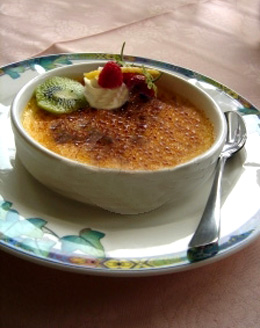
 I met a dear friend for dinner at a fancy restaurant last night. She thinks I'm funny so I was very funny. We talked about serious things and light things and gossipy things for several hours. It was good to be with her to relax, catch up and let our hair down.
 This friend spent many years enmeshed in a very dysfunctional situation. She was able to extricate herself from it fairly recently and seems to be revelling in her new-found liberty. She told me stories about her recent adventures and experiences, none of which I related to but which were often very amusing.
I told her about my life; how I'm very happy and excited about where I am and what's happening spiritually and how I feel like something about myself in relation to my family needs to change but that I don't know what and I don't know how (other than to pray about it). She was kind and supportive.
When I awoke this morning my first impulse was to judge myself kind of negatively for straying so far from my intention to remain centered on God yesterday (see the immediately preceding post) but the more I thought about it, the more I see that it's ok to be me. This friend does not have an awareness of spiritual center. I think, if pushed, she would identify as atheist. We've been friends for a long time through lots and lots of changes. We have a relationship based on shared interests, history, mutual love, respect and admiration. She listened openly as I talked about my growing awareness of God's will for me and how exciting it is for  me to learn to be faithful. She told me about how perplexing her new life can be in the midst of the pleasure of her new-found freedom. We told each other things in trust and with love, expecting support and listened without judgment. The last thing in the world I want to be is like born-again christians who get all self-righteous, eschewing sinful others.
 me to learn to be faithful. She told me about how perplexing her new life can be in the midst of the pleasure of her new-found freedom. We told each other things in trust and with love, expecting support and listened without judgment. The last thing in the world I want to be is like born-again christians who get all self-righteous, eschewing sinful others.
Even though I wasn't consciously aware of Spirit, I know that I acted in accord with my understanding of God's will for me.
Friday, March 21, 2008
As I Am Able
Most every morning I stay in bed and pray. Usually, I state my intention to be open to God's will for me, silently saying something like:
"My body,
my spirit,
my mind to God.
As I am able,
all that I am,
I give
to God."
(I sometimes make this a physical prayer by standing and using gestures and movement)
Usually, I pray for God to guide me and use me and I ask God to help me remain centered on what is of God.
And then I leave my room and immediately forget. I'm like one of the unfortunate people with the capacity to remember things for only a couple of minutes. "God, help me to remain focused on you...Hey! What's for breakfast?"
Until I learn to be faithful in the day-to-day, here and now, I can't imagine growing in the Light. I think humility is what it all comes down to, for me. Humility is, like, exactly the opposite my personality and who I am. I'm loud and boisterous and ME! ME! ME! When I do something good I usually want to crow about it, which, of course, is completely counter to humility.
Tilden Edwards, in his book, Living in the Presence, gives a nice description of the Ego of ME! ME! ME! versus the ego of self to be used by God. In the exercise on Daily Examen he writes, "...If you remember a strong, protective holding on to ego self-image, you might pray 'Lord (or God) have mercy,' very simply desiring the attachment to that image to lighten. If on the contrary you notice that ego self-image was only lightly present, functioning as a vehicle of understanding and activity without a character of ultimacy, you can simply smile to God with thanksgiving. Thus you are noticing both the hidden presence of God in the day and your own way of participating in, missing, or resisting that presence."
I understand that if God to were to call me, really call me to my life's purpose, I'd charge full-steam ahead. I'd leap in and through and MAKE IT HAPPEN (whatever IT were). I'd follow the letter of God's plan without paying a lot of attention to the spirit of it. I'd have God in mind for the outcome but wouldn't be so aware of God in the details. Hmmm...Who was it who said, "God is in the details"?
So, today I pray for humility. I pray for awareness of God using the me-ness of me as a vehicle of understanding and activity. I ask God to help me remain aware of God in each moment as clearly as I am right now. I can't seem to do this on my own so I pray for God to help me.
"My body,
my spirit,
my mind to God.
As I am able,
all that I am,
I give
to God."
(I sometimes make this a physical prayer by standing and using gestures and movement)
Usually, I pray for God to guide me and use me and I ask God to help me remain centered on what is of God.
And then I leave my room and immediately forget. I'm like one of the unfortunate people with the capacity to remember things for only a couple of minutes. "God, help me to remain focused on you...Hey! What's for breakfast?"
Until I learn to be faithful in the day-to-day, here and now, I can't imagine growing in the Light. I think humility is what it all comes down to, for me. Humility is, like, exactly the opposite my personality and who I am. I'm loud and boisterous and ME! ME! ME! When I do something good I usually want to crow about it, which, of course, is completely counter to humility.
Tilden Edwards, in his book, Living in the Presence, gives a nice description of the Ego of ME! ME! ME! versus the ego of self to be used by God. In the exercise on Daily Examen he writes, "...If you remember a strong, protective holding on to ego self-image, you might pray 'Lord (or God) have mercy,' very simply desiring the attachment to that image to lighten. If on the contrary you notice that ego self-image was only lightly present, functioning as a vehicle of understanding and activity without a character of ultimacy, you can simply smile to God with thanksgiving. Thus you are noticing both the hidden presence of God in the day and your own way of participating in, missing, or resisting that presence."
I understand that if God to were to call me, really call me to my life's purpose, I'd charge full-steam ahead. I'd leap in and through and MAKE IT HAPPEN (whatever IT were). I'd follow the letter of God's plan without paying a lot of attention to the spirit of it. I'd have God in mind for the outcome but wouldn't be so aware of God in the details. Hmmm...Who was it who said, "God is in the details"?
So, today I pray for humility. I pray for awareness of God using the me-ness of me as a vehicle of understanding and activity. I ask God to help me remain aware of God in each moment as clearly as I am right now. I can't seem to do this on my own so I pray for God to help me.
Tuesday, March 18, 2008
Classism Class
I was a weekend FAP(Friendly Adult Presence) at the Southern Appalachian Young Friends (SAYF) retreat this weekend here in Nashville. A nice time was had by all, if not a lot of sleep. SAYFers came from Beria, Chapel Hill, Atlanta, and Knoxville. The Chapel Hill folks drove 11 hours to get here and the Atlanta folks got stuck in traffic and sat on the interstate for over two hours on their way, so people arrived quite late. It took a long time before the young people were sufficiently calm enough to be quiet and I wasn't able to fall asleep until 3:30 or so (to the sounds of someone playing the piano and a couple of people drumming along on the floor).
Dick had all the "night shepherds" lined up but one had to cancel due to a death in her family. Hammy would have taken her place but Zed and Carmac got sick. Dick would have done it but I insisted that I would (Dick's just getting over the flu. He's a stubborn man). Kit was the other night shepherd for that time slot (12-3:30). The kids didn't settle down until after 1:00 so we didn't have too much checking to do and, as this is a really fantastic group of young people, no problems.
Kit and I were able to sit and talk about our spiritual formation groups and other things. We talked a lot about classism and lack of diversity in our meeting. I told her that I feel really called to bring more Light to this in NFM. She agrees and is open to exploring. We were talking about when we could do it and both bemoaned the fact that we only have adult ed twice a month and it's usually very hodge-podge in it subject matter and often scheduled months in advance. Currently, meeting for worship is 10:30-11:30 with adult ed or other activity after. I suggested that we could have an on-going discussion group/class/worship sharing on the subject of classism/racism/diversity for an hour before meeting for worship. She suggested that maybe this would be good to try during the summer months. I think there are at least one or two others in GIL who will be interested in pursuing this topic in greater depth. We have our GIL large group meeting this evening so I shall introduce the idea and see how it flies.
Here are some ideas I have for this class:
-a worship-sharing about our earliest memories of class or economic differences.
-in class, each person writes a 1-2 page biography about his or her class/socio-economic history. The next week, we hand the biographies out at random and read them aloud and share reactions, observations and comments.
-Talk about our individual experiences of feeling like an outsider in NFM: When, why and how? When do we feel included? What were first impressions? What was/is welcoming?
-Book discussion "White Like Me" by Tim Wise.
-"What are you hiding" worship sharing about things we are/think/do that we feel would not "sit well" with NFM and thus, keep hidden.
-"What Privileges" exercise from Jeanne's blog.
I led an adult ed about this topic a month or so ago. It went OK. I didn't feel too great about it because I don't think I was focused enough to make it a good discussion. I had so many ideas I wanted to hit and activities I wanted to lead that I was really scattered. We wound up talking mostly about how welcoming our meeting is to newcomers and how we might be perceived to others who know nothing about us. This topic is too big for just one hour one time. I feel this should be an on-going discussion to help us become and remain aware of who we are and who we want to be as a community.
Dick had all the "night shepherds" lined up but one had to cancel due to a death in her family. Hammy would have taken her place but Zed and Carmac got sick. Dick would have done it but I insisted that I would (Dick's just getting over the flu. He's a stubborn man). Kit was the other night shepherd for that time slot (12-3:30). The kids didn't settle down until after 1:00 so we didn't have too much checking to do and, as this is a really fantastic group of young people, no problems.
Kit and I were able to sit and talk about our spiritual formation groups and other things. We talked a lot about classism and lack of diversity in our meeting. I told her that I feel really called to bring more Light to this in NFM. She agrees and is open to exploring. We were talking about when we could do it and both bemoaned the fact that we only have adult ed twice a month and it's usually very hodge-podge in it subject matter and often scheduled months in advance. Currently, meeting for worship is 10:30-11:30 with adult ed or other activity after. I suggested that we could have an on-going discussion group/class/worship sharing on the subject of classism/racism/diversity for an hour before meeting for worship. She suggested that maybe this would be good to try during the summer months. I think there are at least one or two others in GIL who will be interested in pursuing this topic in greater depth. We have our GIL large group meeting this evening so I shall introduce the idea and see how it flies.
Here are some ideas I have for this class:
-a worship-sharing about our earliest memories of class or economic differences.
-in class, each person writes a 1-2 page biography about his or her class/socio-economic history. The next week, we hand the biographies out at random and read them aloud and share reactions, observations and comments.
-Talk about our individual experiences of feeling like an outsider in NFM: When, why and how? When do we feel included? What were first impressions? What was/is welcoming?
-Book discussion "White Like Me" by Tim Wise.
-"What are you hiding" worship sharing about things we are/think/do that we feel would not "sit well" with NFM and thus, keep hidden.
-"What Privileges" exercise from Jeanne's blog.
I led an adult ed about this topic a month or so ago. It went OK. I didn't feel too great about it because I don't think I was focused enough to make it a good discussion. I had so many ideas I wanted to hit and activities I wanted to lead that I was really scattered. We wound up talking mostly about how welcoming our meeting is to newcomers and how we might be perceived to others who know nothing about us. This topic is too big for just one hour one time. I feel this should be an on-going discussion to help us become and remain aware of who we are and who we want to be as a community.
Subscribe to:
Posts (Atom)